
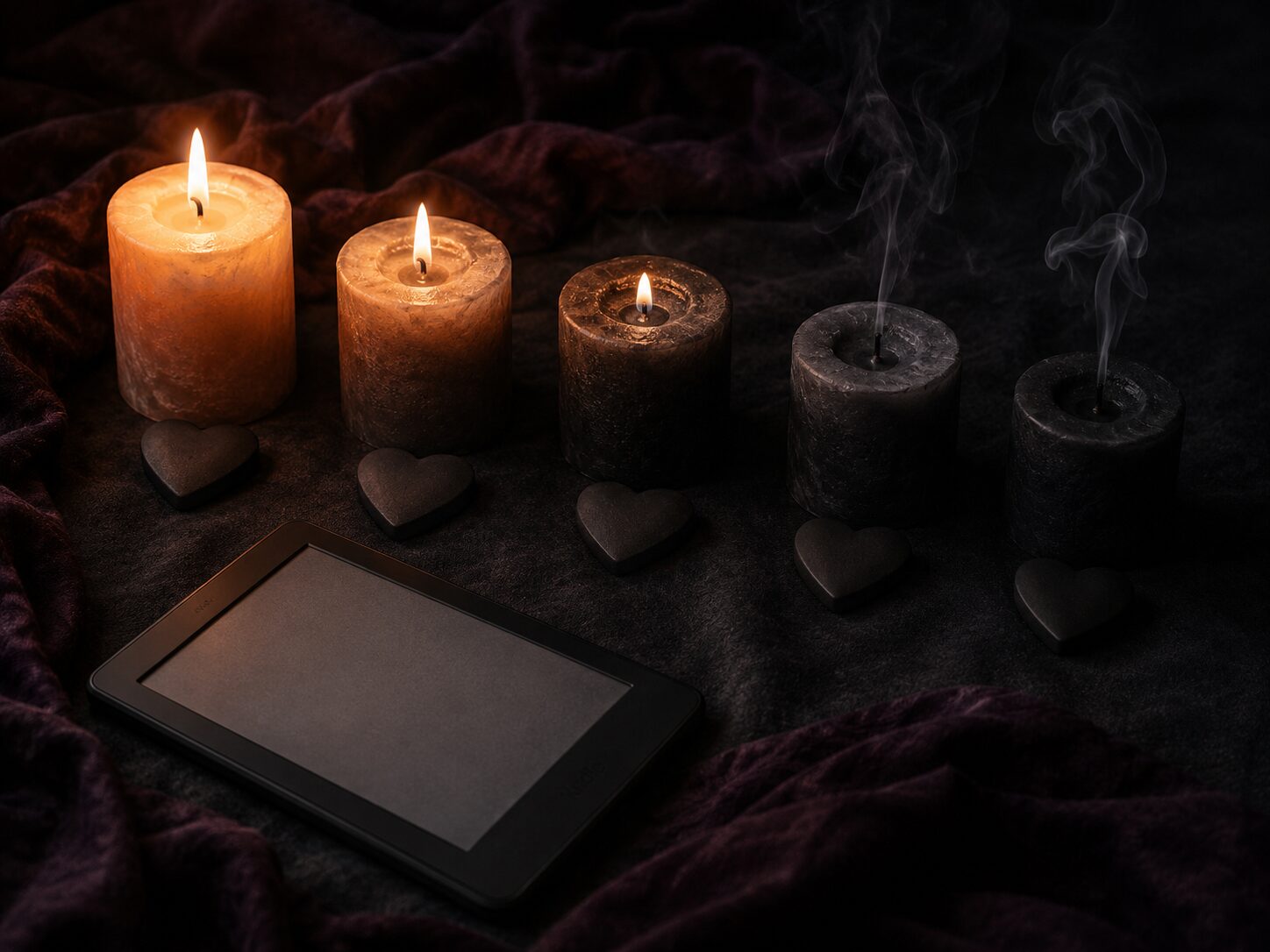
My own darkness rating, five levels from Candlelit to Blackout
Here is the problem with dark romance: “dark” is doing a lot of work in one small word.
One person’s dark romance is a broody man with trust issues and a tragic backstory. Another person’s dark romance is genuinely not okay and comes with a content-warning list longer than the blurb. Both get shelved under the same label, and that is how you end up deep into a book you were absolutely not emotionally prepared for.
So I made a scale. The Blackout Scale is my darkness rating, five levels from Candlelit to Blackout, and it does one job: it tells you how dark a book gets before you start, so you can decide if it is your kind of dark.
Here is the part that makes this scale different from most “how dark is it” lists you will see online. The books the internet loves to call its scariest reads, your Haunting Adelines, your Butcher and Blackbirds, your Lights Outs, sit right at the bottom of my scale. They are the front door, not the deep end. I read a lot of very dark books, and I have calibrated this scale for the whole genre, not just the famous first steps. So a low level here does not mean “tame.” It means “this is where dark romance begins.”
One thing up front, because it matters. This is a comfort tool first and a bit of fun second. The Blackout rating always sits next to the book’s content warnings, never instead of them. The scale tells you how dark. The content warnings tell you exactly what is in it. You need both, and you should always read the warnings.
Darkness is not the same as spice
Quick but important: darkness and spice are two different things, and I rate them separately.
Spice is heat. Darkness is how heavy the themes get. A book can be a Blackout read and barely register on spice, and a five-chilli read can be no darker than Candlelit. If I only gave you a spice rating, you would still have no idea whether you were in for a bit of angst or something that needs a lie down and three business days of silence. So every dark review I write carries both: a Blackout level and a Spice rating, side by side, with the content warnings.
How the Blackout Scale works
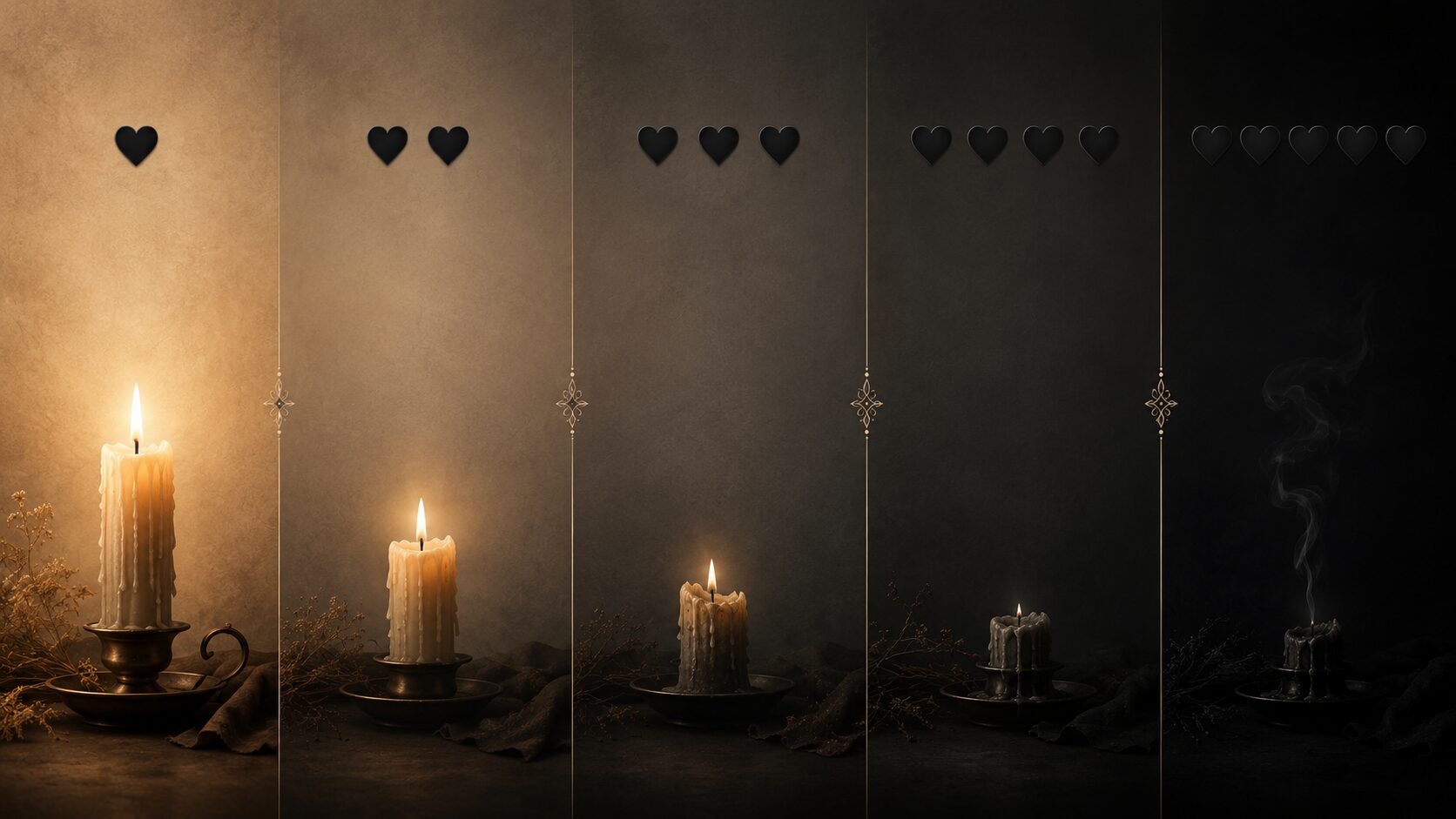
There are five levels, marked in black hearts so they never get muddled with my 🍆️ spice chillies:
- 🖤 Candlelit – dark-adjacent, the gateway
- 🖤🖤 Dimmed – properly morally grey, edges showing
- 🖤🖤🖤 Lights Low – properly dark, earns its warnings
- 🖤🖤🖤🖤 Near Black – heavy and bleak
- 🖤🖤🖤🖤🖤 Blackout – the extreme, taboo deep end
Each level is a range, not a single dot. Two books can both be Candlelit and still be a world apart, so within every level I place a book at the lower end, the mid, or the upper end. That is how Lights Out and Butcher and Blackbird can be the lightest possible Candlelit while Haunting Adeline sits higher up the same level. What moves a book up the scale is not one shocking scene, it is how much of the book lives in the dark: how far the consent goes, how much on-page violence there is, whether the leads are a threat to each other or only to the outside world, and how much comfort the story is willing to give you back.
The example books under each level are my own placements, grouped by the trigger warnings and tropes they carry. Where I have read a book myself the placement is my own call; where I have not, I am going off its content warnings and what the dark romance community consistently says. Either way, treat them as a guide, not gospel, and always check the content warnings for the specific book.
🖤 Candlelit
The front door, and the best place to dip a toe into dark romance. This level is obsession, stalking, morally grey and villain-coded heroes, dark kink, and stylised dubious consent, with violence that is usually pointed at the outside world rather than at the heroine, or played with a knowing wink. These are the most-read, most-memed dark romances going, and for a lot of readers they are the whole genre. On my scale they are where it starts.
- Lower end: Butcher and Blackbird, Lights Out, Sinner’s Retreat (the Slaycation opener)
- Mid: Haunting Adeline
- Upper end: Den of Vipers, God of Malice, The Ritual
Reads like: a possessive, obsessive hero who would burn the world down for her, a serial-killer romance you can somehow root for, notoriety on the cover and a surprisingly soft centre underneath.
🖤🖤 Dimmed
The safety rails start to come off. On-page violence you are meant to take seriously, dubious consent between the actual leads rather than a side villain, heavier BDSM, and revenge plots with a real body count. Still a story most seasoned readers can settle into, but this is where I would tell you to glance at the content warnings first.
- Lower end: The Predator, Insatiable, Sinners Anonymous
- Mid: Little Stranger, I Will Break You
- Upper end: Bad Bishop, The Perfect Fit, Beautiful Venom, Sik Luv (top of the level)
Reads like: a man you should not be rooting for and are anyway, the tension turning genuinely sharp, consequences that land on the page instead of off it.
🖤🖤🖤 Lights Low
Properly dark. Sustained dubious or non-consent between the leads, sadism that is the point rather than the seasoning, captivity starting to appear, on-page torture, and trauma that drives the plot instead of just decorating a backstory. I would not hand anything in this level to someone who told me they wanted “a little bit dark.”
- Lower end: Unhinged, The Lies, Losers Part 1
- Upper end: Beautiful Fiend, Dear Reader, Graves
Reads like: the lights are genuinely low now, the kink has teeth, and you signed up for all of it on purpose.
🖤🖤🖤🖤 Near Black
Heavy and bleak. This level is kidnapping and captivity that lasts, trafficking, Stockholm dynamics, ongoing torture, and abuse inside the central relationship rather than around it. The comfort is scarce and hard-won, and the content warnings are not a formality. Read them in full before you start.
- Lower end: Carnage, Hitched, Untamed Vixen
- Upper end: Red Rabbit, Heavy, Speak
Reads like: you knew what this was, you chose it on purpose, and it still took something out of you.
🖤🖤🖤🖤🖤 Blackout
The deep end, and the whole reason the scale exists. Extreme and taboo content running through the entire book rather than one scene: serial killers as love interests, gore and body horror, snuff-adjacent stakes, extreme non-consent between the leads, and the kind of horror crossover where the romance is almost beside the point. There is very little hand-holding here and not much redemption. This level is only for readers who know exactly what they are walking into and have read every content warning available.
- Lower end: Craving Venom, Buried Beneath Sin, Pretty Poisoned
- Upper end: My Sweet Dollie, You Have To Love Me, Deceiving Their Minds, Axe to Grind
Reads like: the reason “dark romance” needed a scale in the first place. There is no shame in noping out of this level. There is also no shame in living here. Just go in fully informed.
How to use the Blackout Scale
- Pair it with the spice scale. Darkness and heat are different questions. I always give you both.
- Read the content warnings anyway. The level tells you how deep the water is, the lower, mid or upper note tells you where in that level a book sits, and the warnings are the detail. Sites like StoryGraph and Book Trigger Warnings list CWs per book, and I include them on every dark review.
- Know your own comfort level, and honour it. The whole point of this scale is that “dark romance” is not one thing. Candlelit and Blackout are both valid places to read. Pick yours on purpose.

Where should a beginner start?
If dark romance is new to you, start in the Candlelit level, read the content warnings, and work up only as far as you actually want to go. The famous “scary” books everyone talks about live down here for a reason, they are the genre’s gateway. You do not have to prove anything by leaping to a Blackout read. The best dark romance experience is the one you chose with your eyes open.
FAQ
What is the Blackout Scale? It is my darkness rating for dark romance, five levels marked in black hearts: Candlelit (🖤, the gateway), Dimmed (🖤🖤), Lights Low (🖤🖤🖤), Near Black (🖤🖤🖤🖤) and Blackout (🖤🖤🖤🖤🖤, extreme and taboo). Within each level I also note whether a book sits at the lower, mid or upper end. It tells you how dark a book gets before you read it, and it always sits next to the book’s content warnings.
Why is Haunting Adeline only Candlelit? Because I have calibrated this scale for the whole genre, not just the famous first steps. The books the internet calls its darkest, like Haunting Adeline, Butcher and Blackbird and Lights Out, are where dark romance begins for most readers, so they anchor the Candlelit level. Haunting Adeline sits in the middle of Candlelit, with heavier gateway reads like Den of Vipers and God of Malice above it at the top of the level. Candlelit means “the front door,” not “tame,” so always read the content warnings regardless of the level.
How is darkness different from spice? Spice measures heat. Darkness measures how heavy the themes are. They are independent: a book can be very dark and barely spicy, or very spicy and barely dark. That is why I rate them separately and show both on every dark review.
Is dark romance safe to read? Dark romance is fiction that explores intense and sometimes disturbing themes. Whether a specific book is right for you depends on your comfort level, which is exactly what the Blackout Scale plus content warnings are for. Always read the warnings, and never feel you have to push past your limits.
Where should a dark romance beginner start? In the Candlelit level, with the content warnings read first. Work toward the darker levels only as far as you genuinely want to.
Do you rate every book on the Blackout Scale? Every dark romance review, yes, alongside its spice rating and content warnings. Cosy reads do not need it, though a cosy book that is secretly a little dark will get a cheeky 🖤.