

Because “I just have a type” is basically what a trope is
If you have ever been on BookTok, spent any time in a romance reader community, or just tried to describe why you need to immediately read a book your friend recommended, you have encountered romance tropes.
“It is enemies to lovers.” “Forced proximity and I am not okay.” “Grumpy sunshine, small town, he falls first. I do not make the rules.”
Tropes are the shorthand of the romance world. They are the patterns and setups that readers seek out because they work, they deliver, and they scratch a very specific itch in a very satisfying way.
This guide explains what the most popular romance tropes are, what you can expect from each one, and how to use them to find your next read.
What is a romance trope?
A trope is a recurring narrative device, character type or plot setup that appears across many books in a genre. In romance, tropes describe the relationship dynamic, the circumstances that bring two characters together, or the obstacles between them.
Tropes are not clichés. Or rather, they can become clichés in unskilled hands, but in good hands a trope is a promise to the reader. You know going in what kind of story you are getting. The joy is in how the author delivers on it.
When a romance reader asks “what are the tropes?” they are not asking whether the book is original. They are asking whether it is the specific kind of story that will scratch their particular itch right now. The tropes tell them whether they are getting comfort or chaos, heat or slow burn, angst or laughter.
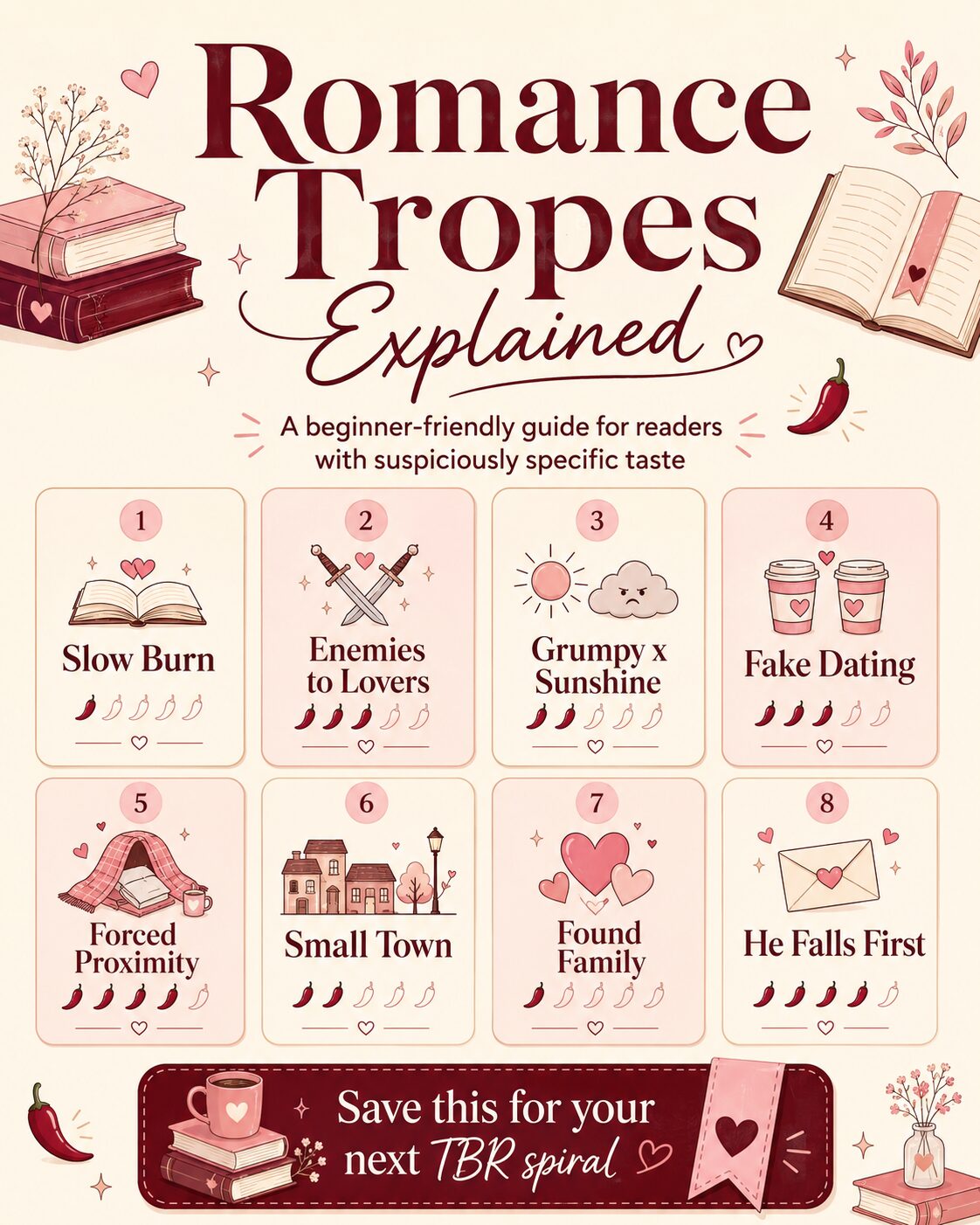
The most popular romance tropes explained
Slow burn
What it means: The romantic tension builds very gradually. There is usually a long period of restraint, awareness, almost-moments and near misses before anything actually happens between the main characters.
Why readers love it: The payoff. A slow burn done well is one of the most satisfying experiences in romance because you have been invested in the tension for so long that when things finally shift, it lands harder.
What to expect: Pining. A lot of pining. Awareness of small details. Hands that almost touch. Scenes where they are very close together for entirely understandable reasons. Readers screaming internally about things they technically already knew were going to happen.
Enemies to lovers
What it means: The two main characters start out actively disliking each other (or at least clashing significantly) before falling in love.
Why readers love it: The banter, the tension and the transformation. There is something uniquely satisfying about watching two people who initially resist each other realise they cannot stop thinking about the other person.
What to expect: Arguments that are also foreplay. Someone being infuriating and attractive at the same time. A specific moment where one or both characters realise something has shifted. Usually excellent banter.
Spectrum note: True enemies to lovers features genuine antagonism. “Grumpy but secretly soft” is often mistaken for enemies to lovers but is closer to grumpy x sunshine, which is its own trope (see below).
Grumpy x sunshine
What it means: One character is reserved, guarded, often grumpy or serious. The other is warm, open, enthusiastic and tends to chip away at the grumpy character’s walls without really meaning to.
Why readers love it: The contrast. The slow thaw. Watching the grumpy one’s defences crumble under the sunshine one’s warmth is deeply satisfying in a way that is difficult to explain and completely understandable if you have experienced it.
What to expect: The grumpy one saying something begrudging that is actually a compliment. The sunshine one making friends with everyone except the grumpy one, who is watching this happen with complicated feelings. The eventual moment where the grumpy one stops fighting it.

Fake dating
What it means: Two characters agree to pretend to be in a relationship for a specific reason (to appease family, to save a social situation, to settle a bet, to protect something). The pretend relationship becomes real feelings.
Why readers love it: All the relationship intimacy with the added tension of pretending. There is something incredibly charged about two people acting like a couple while both privately knowing they are not and both privately realising they might want to be.
What to expect: Accidental tenderness. Moments that start as performance and end up being real. Someone catching feelings and not being able to say anything. A lot of “this is fine, this is just for the arrangement” internal monologue that is not fine at all.
Small town romance
What it means: The story is set in a small, close-knit community where everyone knows everyone, local gossip spreads fast, and the town itself often feels like a character in its own right.
Why readers love it: The sense of belonging and community. Small town romances offer an escape into a world where people look out for each other, traditions mean something and the setting has personality. The community is usually invested in the romance in ways that are chaotic but ultimately kind.
What to expect: Nosy neighbours. A local gossip network that is faster than any algorithm. Community events. Characters from previous books popping in. The town having opinions about the relationship before the couple does.
Found family
What it means: Characters form deep, meaningful family-like bonds with people who are not their biological family. In romance, this often manifests as a close friend group, a community or a blended family situation becoming central to the story.
Why readers love it: It taps into something very fundamental about belonging. Found family stories say that the people who choose you matter just as much as the people you were born into, and that home is something you can build.
What to expect: Characters who are initially isolated or out of place finding their people. Emotional scenes that are not about the romantic relationship but still hit you very hard. A growing sense of warmth and belonging that sneaks up on you.
Forced proximity
What it means: The two characters are pushed into sustained close physical proximity by circumstances outside their control. A snowstorm, a shared living situation, a work arrangement, a carpool. They cannot avoid each other.
Why readers love it: It removes the out. In real life, people can avoid their feelings by simply avoiding the person. Forced proximity eliminates that option and forces the characters (and the reader) to sit with the tension.
What to expect: Awkward shared spaces. Someone noticing how the other person smells. Trying to sleep while being hyperaware of the other person in the room. Domestic intimacy that is not romantic in theory but absolutely is in practice.
Single dad romance
What it means: One of the main characters (usually the love interest) is a single parent, and the relationship dynamic includes the reality of parenting responsibilities, a child character, and the emotional complexity of letting someone new into your family.
Why readers love it: The soft side of a man who is trying. There is something very effective about a competent, often gruff character being genuinely devoted to his child. The love interest being a good dad is a green flag so green it is basically its own genre.
What to expect: A child character who is usually either immediately charming or initially suspicious of the FMC. A moment where the dad does something unexpectedly tender that does irreparable things to the reader’s feelings. The stakes of the romance feeling higher because there is more than just the two adults involved.
Second chance romance
What it means: Two characters who had a prior relationship (or almost-relationship) are reunited and get another shot at what they had or almost had.
Why readers love it: The history and the unfinished business. Second chance romances have an emotional richness that comes from having a backstory. Whatever kept them apart the first time is usually central to the conflict, which means the resolution means something.
What to expect: A lot of “this should not feel like this” energy. Old wounds being reopened and worked through. The bittersweet awareness of time lost. Usually very satisfying endings because the characters have already proven they belong together once.
He falls first
What it means: In the romance, the male love interest realises his feelings and begins to fall before the FMC does (or before the FMC is aware of what is happening on his end).
Why readers love it: Pining from the MMC’s perspective is extremely effective. Watching someone quietly be in love with a person who does not fully see it yet, while the reader can see everything, is a specific kind of reading experience that is difficult to describe and very difficult to put down.
What to expect: Internal monologue from the MMC (if dual POV) that is much more emotionally revealing than his external behaviour. Moments where he does something for her that she reads as nothing in particular and the reader reads as everything. Eventual acknowledgement that is the more satisfying because of how long he has already known.

How to use tropes to find your next read
Most readers have a trope hierarchy. The tropes that they will pick up immediately versus the ones they need the right book for. Getting to know your personal trope preferences makes finding your next read much easier.
Some questions to help you figure out yours:
Do you prefer the relationship to start with friction, or do you want them to like each other from the start? (Enemies to lovers vs friends to lovers)
Do you want high heat, or does the tension do more for you than explicit scenes? (Spice scale)
Do you need external plot conflict, or are you happy if the story is just about the relationship? (Small town cosy vs high stakes)
Do you love community and secondary characters, or do you prefer the focus to stay tightly on the couple? (Small town vs isolated)
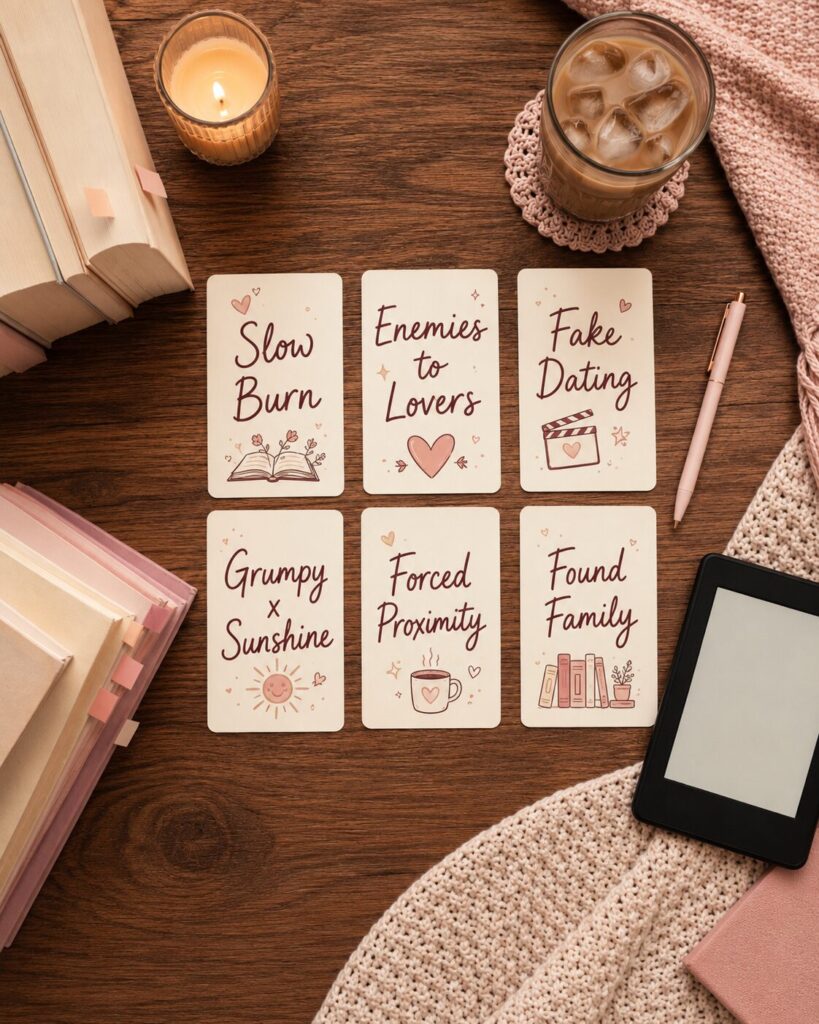
A quick reference: most popular romance tropes
Enemies to lovers, friends to lovers, slow burn, grumpy x sunshine, fake dating, forced proximity, small town, found family, second chance, he falls first, she falls first, forbidden romance, single parent, touch her and die, morally grey MMC, bookish romance, workplace romance, age gap, sports romance (hockey, football, etc.), cowboy romance, and why-choose (reverse harem).
Each of these could be a full post on its own and several of them on this site will be. This guide is your starting point.
Frequently asked questions about romance tropes
What is the most popular romance trope? Enemies to lovers consistently rates as one of the most popular romance tropes on BookTok and in reader surveys, closely followed by slow burn and fake dating. Grumpy x sunshine is also perennially beloved. The short answer is that it depends on your reading community and your personal preferences.
What is the difference between a trope and a cliche? A trope is a recognisable setup or pattern that readers actively seek out. A cliche is when that setup is used without care, originality or character depth. The same trope can be transcendent in one book and flat in another depending entirely on the author’s execution.
Can a romance book have multiple tropes? Yes, and most do. Fake dating and forced proximity often appear together. Slow burn and enemies to lovers are a common pairing. Grumpy x sunshine shows up inside small town romances regularly. Tropes layer and combine. Part of the joy of reading the description of a new book is seeing which combination you are working with.
What is the “why choose” trope? Also called reverse harem, this is a setup where the female main character ends up in a romantic relationship with more than one love interest, and the story does not ask her to choose between them. It has its own subculture within romance and is especially popular in dark romance and romantasy.